
Navigating the New DoD Ban on Chinese Companies and Outside Consultants
The regulatory landscape for Department of Defense (DoD) contractors has experienced a major shift. A strict new compliance mandate has officially gone into effect, heavily restricting federal defense contractors from working with or retaining certain Chinese companies and specific outside consulting entities.
SumX, Inc
July 13, 2026
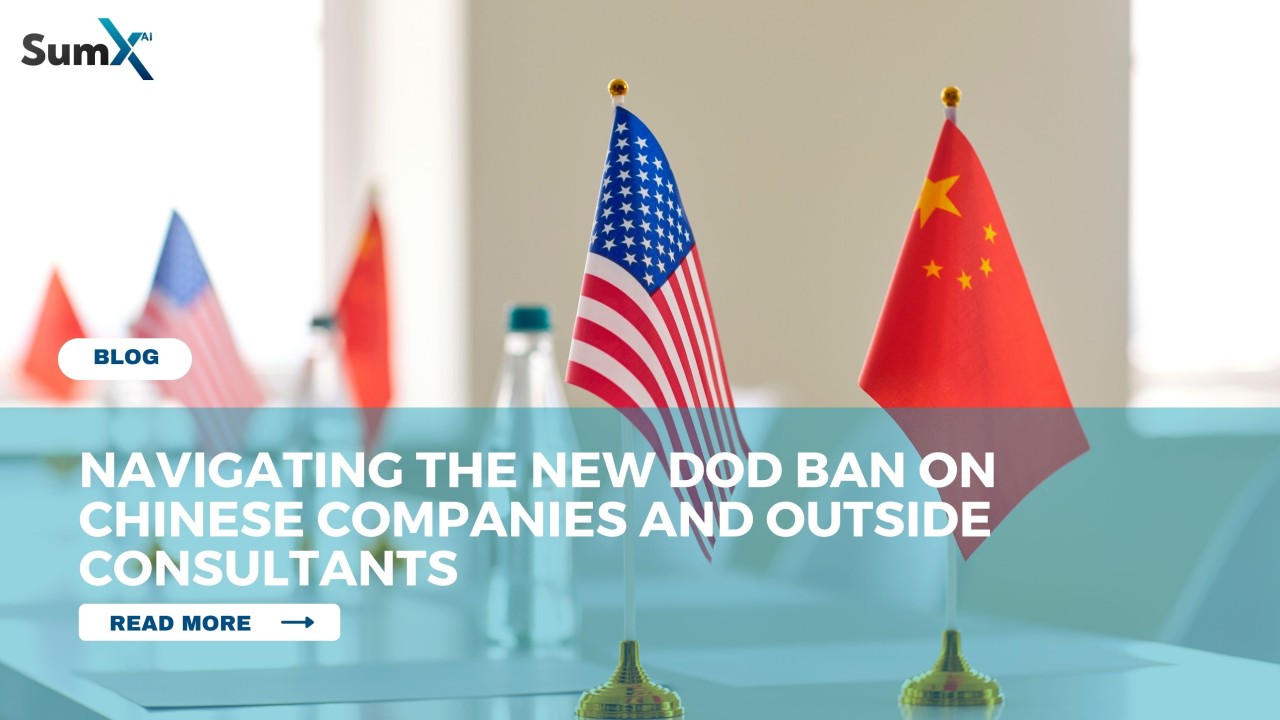
Navigating the New DoD Ban on Chinese Companies and Outside Consultants
The regulatory landscape for Department of Defense (DoD) contractors has experienced a major shift. A strict new compliance mandate has officially gone into effect, heavily restricting federal defense contractors from working with or retaining certain Chinese companies and specific outside consulting entities.
Backed by recent Section 1260H designations and official implementation guidance issued by the Pentagon, this policy represents a significant escalation in supply chain risk mitigation, forcing contractors to thoroughly evaluate their professional networks and lower-tier partnerships.
Here is what defense contractors need to know about this new reality and how to remain audit-ready.
What Does the New Law Restrict?
The new regulation centers on two primary enforcement angles designed to secure national defense secrets, supply chains, and intellectual property:
The Core Chinese Military Company Ban: Under Section 1260H, the DoD maintains a strictly monitored list of Entities Identified as Chinese Military Companies Operating in the United States. Defense contractors are barred from procuring parts, software, technology, or labor from these listed companies or their affiliated entities.
The Outside Consultant Restriction: The law goes a step further by prohibiting defense contractors from retaining certain outside consultants, advisory firms, or third-party brokers who simultaneously maintain active business relationships or advisory roles with restricted Chinese entities or the government of the People's Republic of China (PRC).
The practical consequence is simple: the government wants absolute assurance that no taxpayer funds are flowing, even indirectly, to foreign military competitors through your subcontractors or consulting teams.
Understanding the DoD Implementation Guidance
With the ban officially active, compliance is no longer just a post-award paperwork exercise. Instead, it has been integrated directly into the source-selection phase and contract administration:
Pre-Award Verification: Contracting officers are actively evaluating supply chain transparency during acquisition planning. Failing to demonstrate that your vendor and consulting network is clean can result in immediate proposal rejection or a withheld award.
Performance Risk: If a restricted supplier or prohibited consultant relationship is uncovered post-award, the government can issue a cure notice, pause progress payments, or terminate the contract for default.
Is There an Exception? Navigating the Waiver Process
The government recognizes that in exceptionally rare circumstances, a substitute source may not immediately exist for specialized technology or global mission needs.
Contractors facing an unavoidable touchpoint with a restricted entity must navigate the highly rigid DoD 805 Waiver Request Process. To secure an approved waiver, contractors must submit an exhaustive justification package proving:
Critical Mission Need: The contract objective cannot be completed without the restricted source.
No Substitute Source: No viable alternative exists that fits the technical requirements or schedule constraints.
Robust Risk Mitigation: A concrete control plan to isolate the restricted entity, alongside a clear, documented "exit plan" detailing how the company will transition to a compliant supplier over time.
How Contractors Can Prepare and Stay Compliant
To minimize compliance risk under the new framework, defense firms should instantly implement structured internal controls:
Audit the Consulting and Supplier Network: Screen all direct partners, sub-tier vendors, and outside advisory consultants against the latest DoD 1260H entity list.
Secure Attestations: Require outside consultants and subcontractors to formally attest that they do not advise or conduct business with prohibited Chinese entities.
Leverage Compliant Systems: Use an advanced, project-based ERP system that provides centralized tracking of vendor documentation, flow-down clauses, and full audit trails to ensure compliance data is organized and available for immediate review.
With the Pentagon stepping up enforcement, proactive supply chain visibility is no longer optional, it is a baseline requirement to win and maintain defense contracts.