
Decoding the Latest Executive Order “Promoting Efficiency, Accountability and Performance in Federal Contracting”
On April 30, 2026, President Donald J. Trump signed the Executive Order “Promoting Efficiency, Accountability, and Performance in Federal Contracting,” marking one of the most significant shifts in federal procurement policy in recent years.
SumX, Inc
May 13, 2026
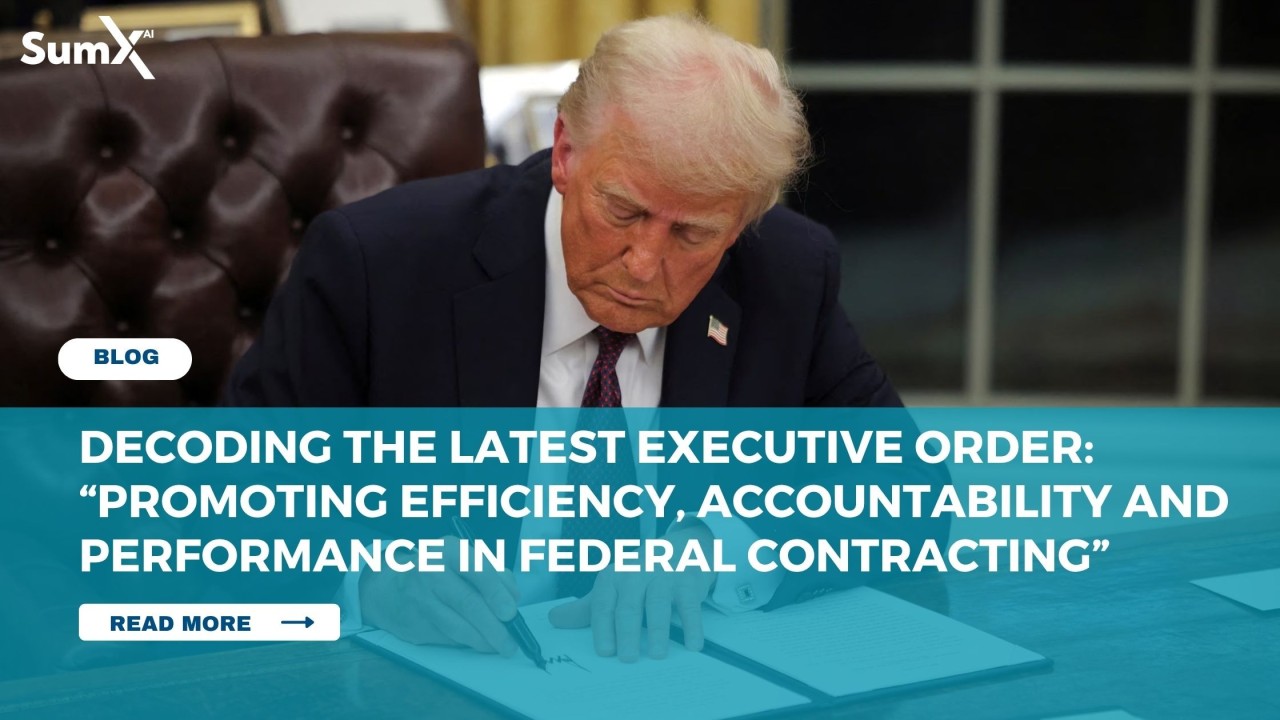
On April 30, 2026, President Donald J. Trump signed the Executive Order “Promoting Efficiency, Accountability, and Performance in Federal Contracting,” marking one of the most significant shifts in federal procurement policy in recent years. The order directs federal agencies to maximize the use of fixed-price contracting and places heightened scrutiny on cost-reimbursement and other non-fixed-price contracts. The Executive Order is part of the administration’s broader acquisition reform agenda and follows the one-year anniversary of the Revolutionary FAR Overhaul (RFO) model deviation guidance.
The administration has justified this transition by emphasizing federal spending trends. According to White House statements, the federal government spent approximately $120 billion on cost-reimbursement consulting contracts alone in Fiscal Year 2024. The administration argues that greater use of fixed-price contracts will improve accountability, reduce cost overruns, and strengthen contractor performance management.
Important Text and Scope of the Executive Order
The Executive Order directs executive branch departments and agencies to utilize fixed-price contracts to the maximum extent consistent with law. Under the order, “fixed-price contracts” include firm-fixed-price contracts, fixed-price incentive contracts, and structures that tie contractor profit to performance metrics and measurable outcomes.
Any use of a non-fixed-price contract must be justified in writing by the contracting officer.
Large non-fixed-price contracts require written approval from the applicable agency head (following the thresholds detailed below).
Agency heads may delegate approval authority, but the order specifies delegation to non-career employees, signaling a preference toward political appointees rather than career acquisition personnel.
The approval thresholds apply not only to fully cost-type contracts, but also to the non-fixed-price portions of hybrid contracts.
Until the FAR is formally amended, agencies are instructed to use FAR deviations to begin implementing the Executive Order immediately.
Approval Thresholds for Non-Fixed-Price Contracts
Department of War: $100 Million
National Aeronautics and Space Administration (NASA): $35 Million
Department of Homeland Security (DHS): $25 Million
All other executive agencies: $10 Million
Implementation Timeline and Administrative Requirements
The Executive Order establishes several aggressive implementation deadlines for federal agencies and procurement leadership.
Within 45 days of the Executive Order (by June 14, 2026), the Director of the Office of Management and Budget (OMB) must issue implementation guidance.
By the end of July 2026, agency heads must review their ten largest non-fixed-price contracts and seek opportunities to modify, restructure, renegotiate, or transition those contracts toward fixed-price arrangements.
Agencies must prepare detailed reports for OMB identifying the number, value, and written justifications for non-fixed-price contracts.
Following the initial reporting period, agencies must continue submitting semi-annual reports to OMB on the number and value of approved non-fixed-price contracts.
By the end of August 2026, the Administrator for Federal Procurement Policy must propose FAR amendments consistent with the Executive Order and establish new training guidance focused on fixed-price contracting.
What’s Changing in Federal Procurement?
The Executive Order signals a major policy shift toward fixed-price and performance-based contracting as the government-wide default approach. While cost-reimbursement contracts are specifically identified as a concern, the practical impact extends beyond cost-type vehicles. Time-and-materials contracts and other flexible pricing arrangements are also expected to face greater scrutiny moving forward.
For federal agencies, the change means stronger emphasis on predictable pricing, measurable deliverables, performance accountability, and tighter contract oversight. Agencies will likely place increased attention on project scoping, contractor cost realism, and milestone-based performance management.
What This Means for the Industry
Fixed-price contracts transfer substantially more financial risk to contractors. Historically, many contractors avoided cost-reimbursement vehicles due to the administrative burden associated with compliance and auditing requirements. However, the increased reliance on fixed-price contracting may reduce the availability of lower-risk contract structures such as time-and-materials contracts.
Contractors may submit inflated proposals to compensate for the additional financial risk associated with fixed-price structures, potentially increasing costs for the government.
Prime contractors may attempt to renegotiate or restructure existing subcontract agreements in order to pass down greater portions of contractual risk to subcontractors.
Performance-based fixed-price service contracts may unintentionally discourage innovation or efficiency if agencies request pricing reductions when work is completed faster or with fewer labor hours than anticipated.
Accurate project scoping, labor forecasting, indirect cost management, and pricing discipline will become increasingly critical for both large and small businesses.
Detailed Risks for Contractors
Contractors operating under fixed-price frameworks face several operational and financial risks that may significantly affect profitability and contract administration.
Rising indirect costs such as health insurance premiums, labor escalation, supply chain volatility, or material price fluctuations may directly reduce contractor profit margins under fixed-price agreements.
Contractors that lack strong cost forecasting and project accounting capabilities may struggle to price contracts competitively while maintaining profitability.
Fixed-Price Profit Reduction Clauses present additional concern. These clauses may permit the government to reduce payment for hours not worked, such as jury duty, military leave, or other approved absences, even when the contractor successfully delivers the required fixed-price outcome.
Contractors with existing non-fixed-price contracts above agency thresholds should anticipate increased performance scrutiny and possible renegotiation activity.
What Contractors Should Do Now
Contractors should begin preparing immediately, even if full implementation of the Executive Order takes time through the FAR rulemaking process. Organizations that proactively strengthen pricing, forecasting, and project management capabilities will be better positioned to compete in the evolving procurement environment.
Conduct profitability and risk analysis on all current non-fixed-price contracts.
Evaluate how existing projects would be priced under a fixed-price model during recompete scenarios.
Strengthen project accounting, forecasting, estimating, and indirect cost management processes.
Review subcontract structures and risk-sharing arrangements.
Invest in systems and internal controls that improve visibility into labor, indirect costs, and project performance metrics.
The Executive Order represents a significant transformation in federal acquisition policy. For government contractors, especially small businesses, success in the coming environment will depend on the ability to accurately estimate costs, manage risk, and demonstrate measurable performance outcomes.
How Can SumX ERP Help Contractors?
As federal agencies move toward fixed-price and performance-based contracting, contractors need stronger visibility into their costs, project performance, and profitability than ever before. SumX ERP helps government contractors prepare for this shift by providing integrated project accounting, cost forecasting, indirect rate management, labor tracking, billing, and real-time financial reporting in a single platform. With greater pressure to accurately price contracts and manage financial risk, contractors can use SumX to analyze historical project performance, monitor budgets against actuals, improve estimating accuracy, and identify profitability risks before they impact the bottom line. SumX also supports compliance-focused workflows and detailed operational reporting, helping contractors make informed decisions, strengthen pricing strategies, and compete more confidently in an increasingly fixed-price federal contracting environment.